Sunday, November 26, 2023

Neoclassical Nostalgia: Exploring the Works of Alexander Pope and Jonathan Swift

105 History of English Literature 1350-1900

Name: Trupti Naik
Batch: M.A Sem 1 [2023-2025]
Enrollment Number : 5108230028
Roll number: 31
E-mail Address: nayaktrupti188@gmail.com

Assignment details:- 

Topic: Neoclassical Nostalgia: Exploring the Work of Alexander Pope and Jonathan Swift

Paper:105: History of English Literature From 1350-1900
Subject code: 22396
Submitted to:- S.B. Gardi, Department of English, MKBU, Bhavnagar
Date of Submission:- 01 December,2023

The Neo-Classical Age, also known as the Age of Reason or the Enlightenment, lasted from 1660 to 1788It was a period of artistic and literary movement that influenced culture. The movement originated in Rome and became popular in France.

The Neoclassical Age was also a period of: 

  • Political and military unrest

  • British naval supremacy

  • Economic growth

  • The rise of the middle class

  • Colonial expansion

  • The rise of literacy

  • The birth of the novel and periodicals

  • The invention of marketing

  • The rise of the Prime Minister

  • Social reforms

 Alexander Pope


Alexander Pope, (born May 21, 1688, London, England—died May 30, 1744, Twickenham, near London), poet and satirist of the English Augustan period, best known for his poems An Essay on Criticism (1711), The Rape of the Lock (1712–14), The Dunciad (1728), and An Essay on Man (1733–34). He is one of the most epigrammatic of all English authors.


His writing style


Alexander Pope, an 18th-century poet, is renowned for his distinctive writing style, often characterized as neoclassical and marked by its precision, clarity, and polished form.


Pope is most famous for his use of heroic couplets, a rhyming pair of lines in iambic pentameter. He perfected this form, employing it in many of his works, including "The Rape of the Lock" and "The Dunciad." His skillful use of this structured verse form allowed for concise expression and balance in his poetry. Pope's writing often contains biting satire and keen wit. He was adept at using satire to critique the society, politics, and culture of his time. "The Rape of the Lock" is a prime example, satirizing the triviality of social etiquette and aristocratic society.


His writing is characterized by clarity, precision, and economy of words. Pope was meticulous in his choice of words and their arrangement, aiming for maximum impact and clarity of expression. Pope frequently used classical allusions and vivid imageries drawn from nature and classical literature. These elements added depth to his work and often served as a means to enhance the understanding of his themes.


The Rape of the Lock


Pope, in his poem, elevates this incident to an epic scale, employing grand language and epic conventions to narrate the story. The poem begins with an invocation to the Muse and presents Belinda, a beautiful young woman, as the protagonist. Belinda's lock of hair becomes the central object of desire and conflict in the narrative.

Pope employs wit, irony, and humor to highlight the absurdity of the situation, ultimately aiming to gently satirize the aristocratic society's trivial obsessions and exaggerated reactions. The poem is known for its clever use of language, its satire of social customs, and its skillful blending of the serious and the trivial.


One of the central themes of “The Rape of the Lock” is morality and the development of virtue. Because the poem is a satire, a textual example of a moral or virtuous person is absent from the poem itself, but Pope uses the characters to reveal an absence of morality or virtuousness. Ironically, the most moral character of the text is Ariel, a sylph whose purpose is to protect Belinda from making immoral choices, but even he falls short of moral obligations.


 Social Satire in Rape of the Lock

Alexander Pope was one of the best satirists England has ever produced. The function of a satirist is didactic and his object is the reformation of humankind and their follies and foibles. The satirist has a yardstick of conduct. He has weapons like wit, mockery, humor, ridicule and irony. Pope has been accused of venom and pungency, which are attributed to his physical deformity. However, a close look at the Rape of the Lock would show that Pope has a wide range and, unlike Swift, he is quite capable of sympathetic understanding, ironic humor, as well as venomous castigation. Nevertheless, most of the time, he is elegantly polished and can say the bitterest thing with urbanity.

Why Pope Wrote the Rape of the Lock as a Social Satire?

The event of the writing of The Rape of the Lock was a quarrel between two families over a trifle, the cutting of a lock of hair of a girl by a lord. The Pope was commissioned to write a poem to make the two families laugh it away. It was a difficult task because Pope had to point out the triviality of the episode without giving offence to either party. Judging by the events, Pope perhaps did not succeed because the Lord in question married another woman with greater fortune, but the result was an incomparable mock-heroic poem. 

The poem is incomparable in design and execution, with a combination of the gay and the serious, and the sparkle of wit and humor, which it irradiates. When Pope began the poem, he meant to concentrate upon the woman in question, but he was so carried away by the subject, he slipped from particular to the general. Belinda became a representative figure of the 18th century high society and Pope’s picture of her turned out as a satirical picture of that society.


Pope’s Sincerity Towards Belinda’s Beauty:

It is averse that Pope’s attitude towards women was disdainful, perhaps because of a lack of sympathetic understanding on the part of women for the deformed poet. However, there are many indications in the poem to show that a sweeping statement of this kind is unfair. In the beginning of the poem, Pope pays homage to the beauty of Belinda, which has a ring of sincerity in it.


The poem’s center of focus is around the experience of a beautiful woman, Belinda, who lost her lock of remarkable hair to a nobleman known as the Baron. As the poem goes along, it steadily becomes sillier and sillier and the characters collapse into a battle over the lock. Pope also added Clarissa’s speech into the poem, which argues that women spend much time on their looks rather than thinking to become a better person and serve society. The main thesis of Pope was that this kind of self-obsession is useless and radically nonsense. However, the poem’s conclusion seems to suggest that true beauty would be of some value, but if it becomes the subject of poetry, thus it achieves a kind of literary immortality.


 Immorality and Carefree Nature of Upper Class:

Pope has presented that in a matter of times the careless and casual response of high society is dangerous. He presented the society where the upper class is busy in pursuit of their own goals through trivial and vain. He portrayed that upper-class people just think about themselves and obsessions. In this poem, the society displayed is one that fails to distinguish between things that matter and things that do not. What they care about is their personal life, luxuries, pomp, vanity. A life that is matchless to the ordinary and the common. He makes fun of their stupid deeds and self-obsessed attentions. He has disguised that this society just leads to immorality and distraction between humans. Alas, in the end, all upper-class people stay empty-handed.

 It is serious that a woman’s hair is cut, but she has rejected a lord and such crimes are frivolities and fun of life in ease of nobility.

Pride in Rape of the Lock

The Rape of the Lock, reveals that the central concerns of the poem is pride, at least for women like Belinda and other social ones found in that society. Pope wants us to recognize that if Belinda has shown all her typical female weakness, then that would be against her pride, partly it is because she has been educated and trained to act in this way. The society as a whole community is as much to blame as she is or the men free from this judgment.


Jonathan Swift


Jonathan Swift, (born November 30, 1667, Dublin, Ireland—died October 19, 1745, Dublin), Anglo-Irish author, who was the foremost prose satirist in the English language. Besides the celebrated novel Gulliver’s Travels (1726), he wrote such shorter works as A Tale of a Tub (1704) and “A Modest Proposal” (1729).


Gulliver’s Travels


Swift’s greatest satire, Gulliver’s Travels, was published in 1726. It is uncertain when he began this work, but it appears from his correspondence that he was writing in earnest by 1721 and had finished the whole by August 1725. 


The Individual Versus Society

Like many narratives about voyages to nonexistent lands, Gulliver’s Travels explores the idea of utopia—an imaginary model of the ideal community. The idea of a utopia is an ancient one, going back at least as far as the description in Plato’s Republic of a city-state governed by the wise and expressed most famously in English by Thomas More’s Utopia. Swift nods to both works in his own narrative, though his attitude toward utopia is much more skeptical, and one of the main aspects he points out about famous historical utopias is the tendency to privilege the collective group over the individual. The children of Plato’s Republic are raised communally, with no knowledge of their biological parents, in the understanding that this system enhances social fairness. Swift has the Lilliputians similarly raise their offspring collectively, but its results are not exactly utopian, since Lilliput is torn by conspiracies, jealousies, and backstabbing.

It's a satirical work that follows the voyages of Lemuel Gulliver, a ship's surgeon, who narrates his adventures in four parts, each describing a different journey to fantastical lands.

In the first part, Gulliver travels to Lilliput, a land of tiny people, where he is a giant among them. Here, Swift uses the size difference to satirize various aspects of European society, including political and social issues, by presenting them in a distorted, miniature form.

The second voyage takes Gulliver to Brobdingnag, a land of giants, where he becomes the miniature being surrounded by enormous inhabitants. This part of the novel allows Swift to reverse the satire, highlighting the flaws of human nature when seen from the perspective of a vulnerable, small individual in a world of giants.

The third part sees Gulliver visiting the floating island of Laputa, where he encounters absurd scientific and intellectual pursuits, poking fun at the impracticality and detachment from reality often found in academia.

Finally, in the fourth part, Gulliver visits the land of the Houyhnhnms, intelligent and rational horses, and the brutish, human-like Yahoos. This part serves as a critique of human nature, society, and behavior, contrasting the noble, rational horses with the savage and base Yahoos.

Throughout the novel, Swift uses the different societies encountered by Gulliver to satirize various aspects of 18th-century English society, including politics, religion, science, and human nature. The book is celebrated for its wit, satire, and timeless commentary on the flaws and follies of humanity.


Conclusion


Alexander Pope and Jonathan Swift expressed neoclassical nostalgia by drawing inspiration from classical literature and philosophy. Pope and Swift, through their respective works, embody the neoclassical spirit by using wit, satire, and classical literary elements to reflect on and critique the societal norms, values, and follies of their time. Their works serve as enduring reminders of the neoclassical era's emphasis on reason, restraint, and the examination of human nature within the framework of classical ideals.


References


Albert, Edward. History of English Literature. Oxford University Press, 22 June 2017.

Butt, John Everett. "Alexander Pope". Encyclopedia Britannica, 10 Sep. 2023, https://www.britannica.com/biography/Alexander-Pope-English-author. Accessed 26 November 2023.


Cregan-Reid, Vybarr , Quintana, Ricardo and Bauer, Pat. "Gulliver’s Travels". Encyclopedia Britannica, 16 Oct. 2023, https://www.britannica.com/topic/Gullivers-Travels Accessed 26 November 2023.


pope, Alexander. The Rape of the Lock. Alma Classics, 18 July 2018.

Quintana, Ricardo and Luebering, J.E.. "Jonathan Swift". Encyclopedia Britannica, 15 Oct. 2023 ,https://www.britannica.com/biography/Jonathan-Swift Accessed 26 November 2023.


Word count : 2054

Images : 2  


Friday, November 24, 2023

The Influence of Nature in Robert Burns Poetry

102 Literature of the Neo Classical Periods


Name: Trupti Naik

Batch: M.A Sem 1 [2023-2025]

Enrollment Number : 5108230028

Roll number: 31

E-mail Address: nayaktrupti188@gmail.com

Assignment details:- 

Topic: The Influence of Nature in Robert Burns Poetry

Paper: 102 Literature of the Neo classical period

Subject code: 22393

Submitted to:- S.B. Gardi, Department of English, MKBU, Bhavnagar

Date of Submission:- 01 December,2023

Robert Burns:-


Robert Burns, (born January 25, 1759, Alloway, Ayrshire, Scotland—died July 21, 1796, Dumfries, Dumfriesshire), national poet of Scotland, who wrote lyrics and songs in Scots and in English. He was also famous for his amours and his rebellion against orthodox religion and morality.


Development as a poet:-

Burns developed rapidly throughout 1784 and 1785 as an “occasional” poet who more and more turned to verse to express his emotions of love, friendship, or amusement or his ironical contemplation of the social scene. But these were not spontaneous effusions by an almost illiterate peasant. Burns was a conscious craftsman; his entries in the commonplace book that he had begun in 1783 reveal that from the beginning he was interested in the technical problems of versification
 

Legacy of Robert Burns:-

Burns was a man of great intellectual energy and force of character who, in a class-ridden society, never found an environment in which he could fully exercise his personality. It may be argued that Scottish culture in his day was incapable of providing an intellectual background that could replace the Calvinism that Burns rejected, or that Burns’s talent was squandered on an Edinburgh literati that, according to English critics, were second-raters. Yet he lived during the cultural and intellectual tumult known as the Scottish Enlightenment, and the problem was ultimately more than one of personalities. The only substitute for the rejected Calvinism seemed to be, for Burns, a sentimental Deism, a facile belief in the good heart as all, and this was arguably not a creed rich or complex enough to nourish great poetry. That Burns in spite of this produced so much fine poetry shows the strength of his unique genius, and that he has become the Scottish national poet is a tribute to his hold on the popular imagination.


Inspiration and Observation:

Nature was Burns' muse. He found inspiration in the rolling hills, the meandering rivers, the changing seasons, and the diverse flora and fauna. He had a keen eye for detail, observing the nuances of nature—the way a flower bloomed, the flight of a bird, or the movement of the wind. His observations allowed him to infuse his poetry with vivid imagery and sensory descriptions, bringing nature to life on the page.


Emotional Connection:

For Burns, nature wasn't just a subject; it was a source of emotional resonance. He felt a deep spiritual connection with the natural world, often finding solace, reflection, and a sense of belonging in its embrace. In his works, he expressed a range of emotions inspired by nature—joy, melancholy, awe, and gratitude.


Symbolism and Metaphor:

Nature served as a powerful metaphor in Burns' poetry. He used natural elements to symbolize human experiences, emotions, and relationships. Whether it was comparing a lover to a red, red rose or reflecting on life's fleeting nature akin to the passing of seasons, he skillfully utilized nature as a lens through which to explore profound themes.


Love and Nature:

Burns frequently intertwined themes of love with nature. His famous poem "A Red, Red Rose" draws parallels between the enduring nature of love and the beauty of natural elements. Nature serves as a metaphor for emotions and human experiences, lending depth and vividness to his romantic verses.


Celebrating Simple Pleasures:

In his works, Burns celebrated the simple pleasures derived from nature—a beautiful sunset, the charm of a country lane, the song of a bird, or the fragrance of a flower. He found solace and inspiration in these everyday occurrences, emphasizing their significance in the human experience.


'A Red Red Rose' 


A Red, Red Rose is known as a pre-romantic poem, as Robert Burns was a poet who influenced Romanticism (1790-1850). The Romantic Movement characteristics of strong feelings, emotions, and the glorification of nature can be seen in the poem’s narrator explaining his passionate, everlasting love through comparison to a lasting red rose in bloom.


"A Red, Red Rose" by Robert Burns can be described in terms of nature through its vivid imagery and comparisons to elements found in the natural world.

The poem uses the metaphor of a red rose to describe the poet's love. The comparison to a rose, particularly a "red, red" one, evokes the beauty, freshness, and vibrancy of nature. It captures the essence of the natural world's vivid colors and fragrant blossoms.

The line "O my Luve's like the melodie That’s sweetly play'd in tune!" compares the poet's love to a sweet melody, likening the feelings to the harmonious and delightful sounds found in nature, perhaps the melodious tunes of birds or the rustling of leaves in the wind.

Additionally, the references to seas, rocks, and sands invoke the vastness and enduring quality of nature. The imagery of the seas going dry and the rocks melting with the sun portrays a sense of timelessness and the constancy of the poet's love, drawing parallels to the enduring nature of natural elements.

Nature plays a significant role in "A Red, Red Rose" by Robert Burns as it serves as a metaphorical backdrop that enhances the depth and significance of the poet's love. The poem draws heavily from the imagery and elements of nature to vividly describe the intensity and enduring nature of the speaker's affection.

Nature serves as a canvas upon which Burns paints a picture of everlasting love. Its presence in the poem enriches the emotional depth, symbolizing the enduring quality and eternal beauty of the speaker's affection for their beloved.


'To a Mouse'


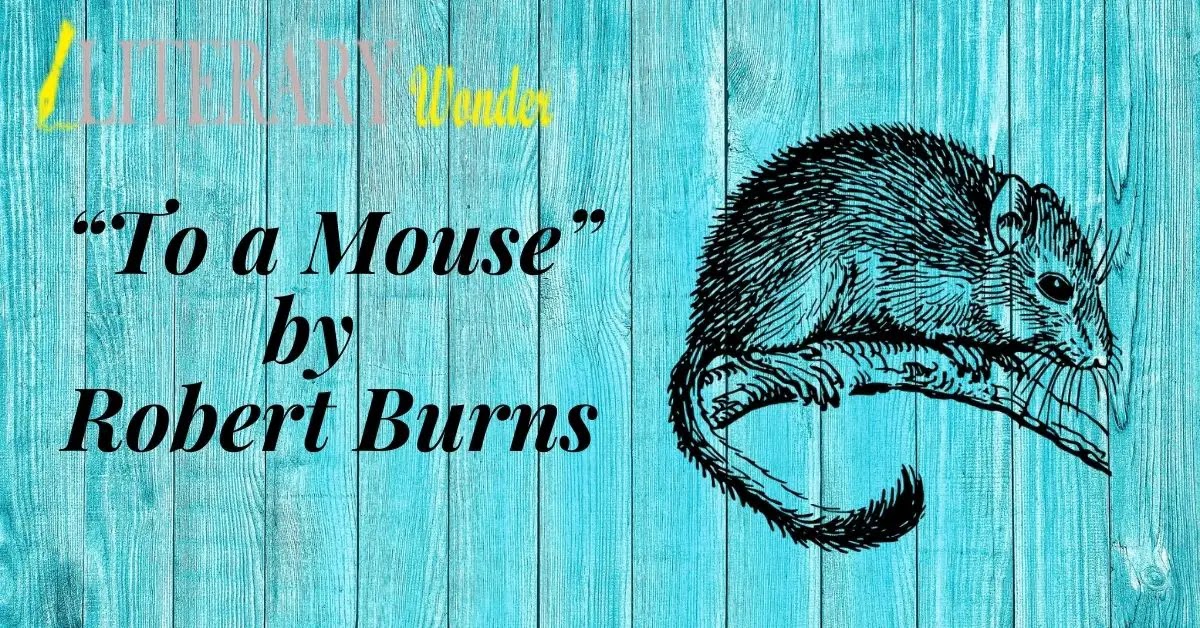
To a Mouse is a famous poem by Robert Burns, written in 1785. It's a heartfelt, introspective piece that addresses a field mouse. The poem was inspired by an incident when Burns accidentally destroyed a mouse's nest while plowing a field. This encounter led him to contemplate the mouse's disrupted life and, by extension, the unpredictable nature of existence.


The title "To a Mouse" refers to Burns directly addressing the mouse, empathizing with its situation and expressing regret for causing its distress. The poem is written in Scottish dialect, adding a distinctive charm to the language used.


In the poem, Burns reflects on how the mouse's carefully constructed home was destroyed and, in doing so, draws a parallel to human experiences. He empathizes with the mouse, acknowledging that despite our best intentions and plans, life can often be uncertain and plans can go awry.


Theme of Nature:-


To a Mouse," the theme of nature is intricately woven throughout the poem, reflecting on the relationship between humanity and the natural world.


Nature, as depicted in the poem, is characterized by its unpredictability and the fragility of life. The mouse's meticulous efforts to build a home are abruptly disrupted, mirroring the sudden changes and uncertainties that can disrupt life in the natural realm. This theme emphasizes the delicate balance and vulnerability of all creatures within their environments.

Burns expresses admiration for the mouse's industriousness and resilience in creating its shelter. He marvels at the mouse's efforts and acknowledges its inherent right to live peacefully, showcasing an appreciation for the natural instincts and endeavors of creatures in their habitats.


The encounter with the mouse leads Burns to introspection. He contemplates the mouse's disrupted life and recognizes the futility of trying to predict or control nature's course. This reflection prompts humility in the face of nature's vastness and the realization of the limitations of human understanding and power over the natural world.

To a Mouse, encapsulates the essence of nature's unpredictability, interconnectedness, and the inherent vulnerability shared by all creatures. It serves as a poignant reminder of humanity's place within the larger framework of the natural world, evoking themes of empathy, admiration, and humility in the face of nature's constant flux and unpredictability.


'The Banks o' Doon'


"
The Banks o' Doon" is a lyrical poem where Burns reflects upon the scenic beauty of the River Doon in Ayrshire, Scotland. The poet vividly describes the landscape along the riverbanks, painting a picturesque scene that captures the tranquility and serenity of nature. The poem not only focuses on the physical attributes of the river but also delves into the emotional connection the poet feels with the surroundings.

Here's an excerpt from "The Banks o' Doon":

"How pleasant thy banks and green valleys below,

Where, wild in the woodlands, the primroses blow;

There oft, as mild Ev'ning sweeps over the lea,

The sweet-scented birk shades my Mary and me."


In this poem, Burns immerses the reader in the beauty of the natural world, highlighting the charm of the riverbanks, the woods, and the blooming flowers. The mention of sharing these scenes with Mary, his muse or love interest, adds a personal touch, infusing the natural setting with emotional depth and significance.

"The Banks o' Doon" exemplifies Burns' ability to intertwine the themes of nature, love, and personal experience, showcasing his appreciation for the serene and idyllic aspects of the natural world while infusing it with sentimental value.


'The Birks of Aberfeldy'


In this poem, Burns celebrates the beauty of nature, specifically focusing on the birch trees (or "birks") in the town of Aberfeldy in Scotland. The poem reflects upon a walk the poet takes through the birch-covered hillsides and the emotional response evoked by the natural scenery.

Here's an excerpt from "The Birks of Aberfeldy":

"Bonnie lassie, will ye go,

Will ye go, will ye go,

Bonnie lassie, will ye go

To the birks of Aberfeldy!"

In this verse, Burns invites a "bonnie lassie" to accompany him to the birch-covered hills of Aberfeldy, emphasizing the allure and beauty of nature as an ideal setting for romantic companionship.

Throughout the poem, Burns vividly describes the landscape, painting a picturesque scene of the birch trees, murmuring streams, and the overall tranquility of the natural environment. He captures the essence of the birch woods' charm and the soothing effect of nature on the human spirit.

"The Birks of Aberfeldy" stands as another testament to Burns' ability to infuse his appreciation for nature into his poetry, portraying the natural world as a source of beauty, tranquility, and inspiration.


Conclusion: 


Nature's importance in Burns' poetry lies in its ability to evoke vivid imagery, emotional depth, and universal themes. Nature isn't just a backdrop in Burns poetry; In "A Red, Red Rose," he compares love to a blooming rose, harnessing nature's imagery to express enduring affection. "To a Mouse" shows his empathy for nature's vulnerability through the disrupted life of a field mouse. Both "The Birks of Aberfeldy" and "The Banks o' Doon" vividly capture scenic landscapes, revealing Burns deep admiration for nature's beauty.


it's a character itself, reflecting life's unpredictability, resilience, and timelessness. He uses nature's elements to evoke emotion and paint vivid pictures, connecting human experiences to the natural world. Burns's influence on nature lies in how he seamlessly blends human emotions with nature's beauty, leaving a lasting impression that celebrates, reflects upon, and immortalizes the essence of the natural world in his verses.


References:-


 Albert, Edward. History of English Literature. Oxford University Press, 22 June 2017.


Daiches, David. "Robert Burns". Encyclopedia Britannica, 12 Oct. 2023, https://www.britannica.com/biography/Robert-Burns. Accessed 24 November 2023.


Word Count - 1908

Images - 5


Tuesday, November 21, 2023

Photography Workshop

Hello,

This blog is based upon a photography workshop held on 17th August 2023 at English Department, Maharaja Krishnakumarsinhji Bhavnagar University. 


Importance of photography :-

Photography is important because it captures moments, emotions, and memories, allowing us to share, remember, and communicate our experiences visually. It's a powerful way to tell stories, convey messages, and appreciate the beauty of the world around us. Photographs are important in documenting historical events, cultural changes, and social progress. They serve as visual records for future generations. photography is a versatile and powerful medium that impacts our lives in many ways, from preserving memories and communicating ideas to documenting history and fostering artistic expression. 

  On 17th August 2023, at department of English organized photography workshop by Mr. Kaushik Ghelani Sir. He is a wildlife photographer and also a  filmmaker. students from the life science department (mkbu) also joined this workshop. The session hosted by our Senior Trushali Dodiya. 

Kaushik Ghelani sir emphasized that a photograph reflects your unique perspective and is a result of your individual perception. He emphasized the importance of thoughtful consideration before clicking the shutter. Exploring diverse angles, heights, and distances from the subject offers distinctive viewpoints, allowing one to indirectly gain knowledge in various fields. Ghelani himself delved into geography, wildlife, and zoology while pursuing his passion for photography.

He discussed the "Aesthetics of Photography," highlighting that photography goes beyond mere visual appeal. It possesses the profound ability to narrate compelling stories, evoke deep emotions, and document real-life events, places, subjects, and interests with paramount significance.

Learning and applying the rules of photography can significantly enhance the quality and impact of your photos. Whether it's about composition, lighting, or techniques, these rules serve as guidelines to help you create more compelling and visually pleasing images.

1. Centre Focus :-

2. Symmetry :-

3. Geomentric shapes:-

4. Leading Lines :- 

5. Head Leading room:-

6.Golden point:-

7. Death of field:-

8. Break the Rule :-

Break the rule to create something very different from other.

   The photography workshop was divided into two parts, the first part was theory and In the second part they allowed us to click photos around the university.  And In the last he reviewed our work, providing comments and critiques, and announced the three winners.

In conclusion, the photography workshop was an enriching experience that provided valuable insights, practical skills, and a newfound appreciation for the art of capturing moments.

Sunday, November 19, 2023

Youth Festival 2023

This blog is based on Youth Festival 2023 organised by Maharaja Krishnakumarsinhji Bhavnagar University on 2 to 5 November 2023. Youth Festival's theme was Nari Shakti Vandana. 

          Man-Bhavan Yuva Mahotsav 2023      

Maharaja Krishnakumarsinhji Bhavnagar University. 


During the youth festival, I was volunteer and we managed tasks in our department. Our seniors provided guidance and instruction, teaching us how to effectively manage and organize everything and we learned a lot from them. 


On the first day of youth Festival there was a Kala Yatra. In Kala yatra Many colleges came with a various themes. Our English Department presented theme of Oppression to Freedom. 


Various societal roles such as 'Balika Vadhu' (young bride), widow, laborer, motherhood impose distinct expectations and control over women's lives." We're also highlighting themes of female empowerment, showcasing women in professions like doctors,lawyers, dancers, Cricketer and more."

Bound by Expectations: Women and Societal Control


There are numerous themes presented by other colleges in Kalayatra.


At our department, we have three events: a poetry competition, a quiz competition, and an essay competition. 

● Poetry competition:-


 Poetry competition Topics:-

1. ઉમ્મીદ 
2. બાળપણ ખોવાણું 
3. સ્મરણોની કેડીએ
4.જે કર જૂલાવે પારણું 
5. મેરી મિટ્ટી મેરા દેશ 


As a volunteer, we managed various tasks, ensuring smooth operations and assisting participants as needed. The poetry competition itself was a captivating event, showcasing diverse talent and creativity among the participants. The atmosphere was vibrant, and the poems presented were incredibly inspiring, reflecting a wide range of emotions and themes. Overall, it was a fulfilling experience to contribute to the success of the competition and witness the power of poetic expression among the participants. 

● Essay Writing Competition 

Essay writing competitions topics:-

1. India's Space Odyssey 
2. From the Kitchen to Cabinet - Women, Don't Give Up
3. Are Wars Inevitable?
4. The Importance of Value based Education 
5. Plastic Pollution - Problems & Resolution 

The Essay writing competition was impressive! The essays were really interesting, covering lots of different topics. 


Quiz competition 


          The quiz itself was thrilling! Participants showcased their skills, making it an engaging and competitive event. Quiz competition was held in two
 parts.


 In 2nd part there was 5 finalised team of different colleges.  


Participants were buzzing with excitement, answering questions and showing off their knowledge. The questions covered a wide range of topics, and the teams were really competitive. The atmosphere was lively, and it was fantastic to witness the energy and enthusiasm of everyone involved. it was fascinating to see the teams strategize and collaborate. The room was exciting, with people cheering and sometimes feeling disappointed when hard questions popped up. Seeing how much effort everyone put in and how fast they answered questions.


Friday, November 3, 2023

Oscar Wilde's The Importance of Being Earnest

 Hello, 

This blog is based upon thinking activity. 

For further reading you can Visit here

Oscar Wilde (1854-1900) was an Irish playwright, poet, and author known for his wit, flamboyant style, and contributions to literature. Wilde was born in Dublin, Ireland, and attended Trinity College, Dublin, and later Oxford University. 

He is famous for his plays, including "The Importance of Being Earnest" and "An Ideal Husband," as well as his novel, "The Picture of Dorian Gray." His works often explored themes of social satire, aesthetics, and morality. 

1.Wilde originally subtitled The Importance of Being Earnest “A Serious Comedy for Trivial People” but changed that to “A Trivial Comedy for Serious People.” What is the difference between the two subtitles?

"A Serious Comedy for Trivial People": In this subtitle, Oscar Wilde is saying that his play is like a funny story, but it has some important or meaningful ideas hidden in it. So, it's for people who don't usually think deeply but might find something serious in the comedy.

"A Trivial Comedy for Serious People": In this subtitle, he's telling us that the play is lighthearted and funny, but it's meant for people who are usually serious and thoughtful. So, it's a way for serious folks to relax and enjoy something light, even though it might not have deep messages.

So, the difference is in who the play is meant for and what it offers: the first subtitle suggests depth for less serious people, while the second suggests fun for serious-minded folks.

2.Which of the female character is the most attractive to you among Lady Augusta Bracknell, Gwendolen Fairfax, Cecily Cardew and Miss Prism? Give your reasons for she being the most attractive among all.


Cecily Cardew is a significant character in Oscar Wilde's play "The Importance of Being Earnest." She is the young ward of Jack Worthing, one of the play's protagonists. Cecily is portrayed as an imaginative and somewhat naive young woman who lives in the countryside and is deeply engrossed in her romantic fantasies.

Cecily's character is marked by her fascination with the name "Ernest" and her penchant for keeping a detailed diary about her fictitious engagement to an imaginary "Ernest." Her character serves as a contrast to Gwendolen Fairfax, Algernon's love interest, as Cecily represents the innocence and idealism of youth. She also embodies the Victorian fascination with romantic novels and the idea of a dashing and morally flawed hero, which is reflected in her infatuation with the name "Ernest."

Cecily's interactions with other characters, including Gwendolen and Algernon, lead to humorous misunderstandings and add to the play's satirical commentary on the superficiality and trivial concerns of the upper classes. As the play progresses, Cecily's character experiences growth and development, ultimately recognizing the importance of sincerity and truth in love, much like the other characters. Cecily's character adds depth and humor to the play, and her transformation underscores the play's themes of deception, identity, and the nature of true love.

3.The play repeatedly mocks Victorian traditions and social customs, marriage and the pursuit of love in particular. Through which situations and characters is this happening in the play.

In "The Importance of Being Earnest," the play mocks Victorian traditions and social customs, especially regarding marriage and love, through various characters and situations. For instance, Algernon and Jack create fictitious identities to escape societal norms, revealing the absurdity of rigid social expectations. Lady Bracknell embodies the aristocratic obsession with lineage, highlighting the shallow focus on status. Gwendolen and Cecily's obsession with the name "Ernest" satirizes the importance placed on a name in love and marriage. The play humorously exposes the superficiality and hypocrisy of Victorian society.

4. Queer scholars have argued that the play's themes of duplicity and ambivalence are inextricably bound up with Wilde's homosexuality, and that the play exhibits a "flickering presence-absence of… homosexual desire" Do you agree with this observation? Give your arguments to justify your stance.

Yes, I agree with the observation that the themes of duplicity and ambivalence in Wilde's play The Importance of Being Earnest. 

Duplicity and ambivalence are two main themes in Wilde's play. Duplicity means having two different faces or being dishonest. Ambivalence means having mixed feelings about something.

Wilde himself was homosexual, but he lived in a time when homosexuality was illegal and punishable by imprisonment. He had to hide his sexuality from the public, which caused him to feel duplicitous and ambivalent.

The play's homoerotic subtext: There are many homoerotic moments in the play, such as when Jack and Algernon flirt with each other and when they both express their love for the same man, Ernest.

The play's use of doubles and alter egos: Many of the characters in the play have doubles or alter egos. For example, Jack has his alter ego Bunbury, and Algernon has his alter ego Ernest. These doubles can be seen as representations of the characters' hidden selves, including their homosexual desires.

The play's title: The word "earnest" was a slang term for homosexuality in Wilde's time. The play's title can be read as a playful nod to its homosexual subtext, especially given the play's other themes of identity and duplicity.

Criticizing Society: Wilde was making fun of how people in high society acted all proper when they might have secrets of their own. T

I would also add that the play's "flickering presence-absence of… homosexual desire" can be seen in the way that Wilde uses language and imagery. For example, the play is full of double entendres and other forms of wordplay that can be interpreted as both heterosexual and homosexual. Additionally, Wilde uses a number of symbols and images that are associated with homosexuality, such as the handbag that Jack carries and the green carnation that Algernon wears.

This idea makes sense to some people, but not everyone agrees. It's one way to look at the play and its hidden meanings.

5. Various movie and radio adaptations of this play. Write your critique on various adaptations of this play. 


●1952 Movie Adaptation of The Importance of Being Earnest.  

The 1952 movie adaptation of "The Importance of Being Earnest" is a faithful rendition of Oscar Wilde's renowned play. It maintains the clever wit and social satire that Wilde is known for. The movie features strong performances, particularly from the lead actors, Michael Redgrave and Michael Denison, who bring the characters of Algernon and Jack to life with humor and charm.

The movie successfully captures the upper-class English society of the late 19th century, highlighting the absurdities and hypocrisies of the time. The dialogue is filled with Wilde's signature epigrams and clever wordplay, providing plenty of comedic moments for the audience.

However, it's important to note that the movie's pacing and style might feel a bit dated for contemporary viewers. The humor and sensibilities of the early 1950s differ from today's, and this adaptation adheres closely to the theatrical conventions of its time. This means the film lacks some of the dynamic camerawork and editing that modern audiences may expect from a comedy.

In summary, the 1952 adaptation of "The Importance of Being Earnest" is a classic rendition that remains true to Oscar Wilde's work. While its adherence to the theatrical norms of its era might make it less accessible to some modern viewers, it remains a delightful showcase of Wilde's witty writing and satire, offering an insightful glimpse into the societal norms and absurdities of the late 19th century.

1996 Movie Adaptation of The Importance of Being Earnest.

The Movie captures the humor and wit of the original work, and the cast delivers excellent performances. The costumes and sets transport you to the Victorian era. However, some viewers might find the pacing a bit slow, and it may not appeal to those who prefer modern, fast-paced comedies. Overall, it's a charming and well-done adaptation that stays true to the source material.

One of the movie's strengths is its cast, with Colin Firth and Rupert Everett in the lead roles. Both actors deliver strong performances, embodying the characters of Algernon and Jack with charm and charisma. They adeptly convey the characters' dual lives and the humorous situations that arise from their fictional alter egos.

In conclusion, the 1986 movie adaptation of "The Importance of Being Earnest" is a faithful and charming interpretation of Wilde's classic play. It successfully captures the humor and wit of the original work and features strong performances from the cast. While it may not cater to those seeking a fast-paced comedy, it remains a delightful cinematic rendition of one of Oscar Wilde's most renowned works.


Thank you. 

Wednesday, October 25, 2023

Aphra Behn's The Rover

 Hello,  

This blog is a part of thinking activity. 


Question 1. Angellica considers the financial negotiations that one makes before marrying a prospective bride the same as prostitution. Do you agree?

➡In Aphra Behn's play The Rover, Angellica considers the financial negotiations that one makes before marrying a prospective bride to be the same as prostitution. 

Angellica's view of marriage is shaped by the social and economic conditions of her time. In seventeenth-century England, women were largely dependent on men for financial support. Marriage was seen as a way for women to secure their financial future, and dowries were often used to negotiate marriage contracts. This practice could lead to women being treated as commodities, and it is likely that Angellica has seen firsthand the negative consequences of this system.

Angellica sees financial negotiations before marriage, where one party may expect or receive money or assets, as similar to prostitution. In her perspective, both situations involve a form of transaction where one person provides something of value (money or assets) in exchange for a specific kind of relationship, whether it's marriage or companionship in the case of prostitution. 

Question 2. All women together ought to let flowers fall upon the tomb of Aphra Behn, for it was she who earned them the right to speak their minds." Virginia Woolf said so in 'A Room of One's Own'. Do you agree with this statement? Justify your answer with reference to your reading of the play 'The Rover.

➡Virginia Woolf believed that women should honor Aphra Behn because she helped women gain the right to express themselves freely. Woolf thought Behn's work was important in advancing women's voices.

Aphra Behn was one of the first successful female writers in England. She was the first English woman to make a living from her writing, and she wrote in a variety of genres, including plays, poetry, and fiction. Her work was popular with both male and female audiences, and she challenged many of the prevailing social and literary conventions of her time. Aphra Behn's work often dealt with themes of female empowerment and independence. Her plays often featured strong female characters who were not afraid to speak their minds.

Aphra Behn lived in a time when women were expected to be silent and submissive, but she refused to conform to these expectations. She spoke her mind freely, even when it meant facing criticism or ridicule.

In her play The Rover, Behn features a female protagonist, Hellena, who is intelligent, resourceful, and independent. Hellena is not afraid to challenge the male characters in the play, and she ultimately outsmarts them all.

Virginia Woolf's statement about Behn is a reminder of the importance of women's voices in literature and in society as a whole. Aphra Behn's work helped to create a space for women to speak their minds. 

Question 3. Which female character best represents the playwright, Aphra Behn? Consider the characteristics and beliefs of each female character, and make an argument that relates these distinctive attributes to what you know about Behn.

➡The female character who best represents the playwright Aphra Behn is Hellena from her play The Rover. Hellena is a strong, independent, and intelligent woman who is not afraid to speak her mind or challenge the status quo. She is also resourceful and witty, and she is always able to outsmart the men in her life.

Aphra Behn herself was a strong and independent woman who lived in a time when women were expected to be silent and submissive. She refused to conform to these expectations, and she spoke her mind freely, even when it meant facing criticism or ridicule. Behn was also a resourceful and witty writer, and she was able to create complex and believable female characters in her work. 

Both women believe in the importance of female empowerment and independence. Hellena is a woman who is determined to control her own destiny, and she refuses to be defined by the men in her life. Behn herself was a strong advocate for women's rights, and her work often challenged the traditional gender roles of her time.


Thank you.  

Behavioural Communication - 26931

  UNIT 1: FOUNDATIONS OF BEHAVIOURAL COMMUNICATION  Topic 1: Definition, Importance, and Scope of Behavioural Communication Introduction Com...