Thursday, November 14, 2024

201: Indian English Literature – Pre-Independence


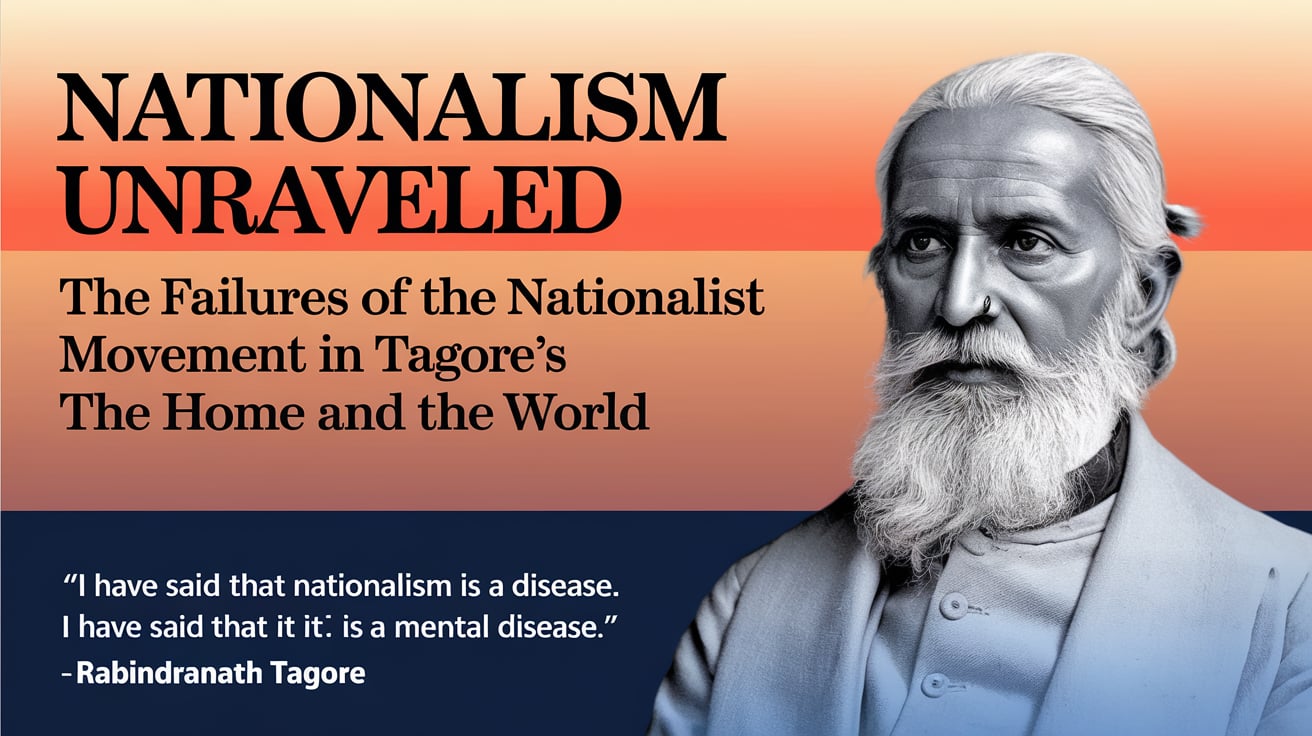
Nationalism Unraveled: The Failures of the Nationalist Movement in Tagore’s The Home and the World


Name: Trupti Naik

Batch: M.A Sem 3 [2023-2025]

Enrollment Number : 5108230028

Roll number: 25 

E-mail Address: nayaktrupti188@gmail.com


Assignment details:- 


Topic: Nationalism Unraveled: The Failures of the Nationalist Movement in Tagore’s The Home and the World

Paper: 201: Indian English Literature – Pre-Independence

Subject code: 22406

Submitted to:- S.B. Gardi, Department of English, MKBU, Bhavnagar


Abstract

Rabindranath Tagore's novel The Home and the World as a critical commentary on the limitations and failures of the nationalist movement in colonial India. Through a detailed analysis of the novel's allegorical elements, character dynamics, and thematic concerns, this study explores how Tagore critiques both militant and rational forms of nationalism while advocating for a more balanced and inclusive approach to national identity. The research particularly focuses on the novel's representation of the tensions between tradition and modernity, the manipulation of gender in nationalist discourse, and the complex relationship between colonial influence and indigenous resistance. Drawing on Tagore's broader philosophical writings and his establishment of Visva-Bharati University, this paper argues that the novel presents a sophisticated critique of narrow nationalism while proposing an alternative vision based on universal humanism and cultural synthesis.


Keywords: Rabindranath Tagore, Indian nationalism, colonialism, Swadeshi movement, gender politics, tradition versus modernity, cultural identity.


 Introduction


The early twentieth century witnessed the rise of nationalist movements across colonized nations, with India at the forefront of anti-colonial resistance. During this transformative period, Rabindranath Tagore emerged as both a participant in and critic of Indian nationalism, offering nuanced perspectives on the movement's ideological foundations and practical implications. His novel The Home and the World (1916) serves as a powerful critique of nationalist ideologies and their impact on Indian society, particularly during the Swadeshi movement. The novel's publication coincided with a crucial phase in India's independence struggle, as the nation grappled with questions of identity, modernization, and resistance to colonial rule. Through its intricate narrative structure and complex characterization, the novel provides a sophisticated analysis of the challenges facing Indian society as it struggled to define its identity and chart its course toward independence.

Historical and Ideological Background

  • The Swadeshi Movement and the Rise of Nationalism: The Swadeshi movement began as a protest against British colonial policies and sought to unite Indians by promoting indigenous goods and self-sufficiency. While the movement inspired patriotic fervor, it also led to economic disruption and social divides within Indian society. Tagore was critical of the movement’s aggressive nationalism, fearing it might devolve into narrow-minded extremism rather than a true pursuit of Indian freedom and identity.

  • Tagore’s Vision of Nationalism: Tagore envisioned a nationalism that was inclusive, grounded in universal values, and respectful of diverse perspectives. His establishment of Visva-Bharati University was an effort to promote a cultural nationalism that celebrated Indian heritage while engaging with global ideas. Tagore’s nationalism was less about political power and more about ethical and cultural integrity, standing in contrast to the Swadeshi movement’s ideological rigidity.


 The Dialectic of Nationalism and Identity


At the heart of The Home and the World lies the complex dialectic between domestic and public spaces, represented through the symbolic opposition of "home" and "world." This spatial dichotomy serves as more than mere setting; it becomes a powerful metaphor for the broader conflicts within Indian society during the colonial period. The home, traditionally seen as a sanctuary of Indian values and cultural authenticity, becomes a contested space where the pressures of political activism and social change intrude upon established hierarchies and relationships. This intrusion represents the larger colonial experience, where traditional spaces and relationships were increasingly destabilized by modern political and social forces.


Women as Symbols of National Identity

The novel's treatment of Bimala's character reveals how nationalist movements often appropriate women's bodies and identities as symbols of cultural purity. Her journey from traditional wife to political actor illustrates:

  • The complex relationship between gender roles and national identity

  • The limitations of women's empowerment within nationalist frameworks

  • The exploitation of feminine imagery in nationalist rhetoric


The novel's critique of nationalist ideologies manifests most powerfully through its three central characters, each representing different approaches to nationalism and modernization. Sandip embodies the dangerous allure of militant nationalism, characterized by emotional manipulation and ethical compromise. His character demonstrates how nationalist movements can exploit genuine patriotic sentiment for personal gain while compromising moral principles in the name of political expediency. Sandip's manipulation of religious and cultural symbols for political purposes reveals the potential for nationalism to become a destructive force when divorced from moral considerations. His charismatic presence and persuasive rhetoric exemplify the seductive power of nationalist ideology, particularly in its ability to mobilize popular sentiment through emotional appeals rather than rational argument.


In contrast, Nikhil represents a more measured approach to nationalism, grounded in rational thought and ethical behavior. His character embodies the liberal, humanist tradition that seeks to reconcile Indian traditions with modern values. However, his eventual failure to prevent the outbreak of violence and protect those he loves suggests the limitations of purely intellectual resistance to colonial power. Nikhil's inability to counter Sandip's emotional appeal to the masses demonstrates the challenges faced by progressive intellectuals in connecting with popular sentiment. This tension between rational and emotional approaches to nationalism forms a central conflict within the novel, highlighting the broader struggles within Indian society to find an appropriate response to colonial domination.


Gender Politics and Cultural Identity

The Paradox of Female Emancipation

Tagore demonstrates how nationalist movements simultaneously promote and restrict women's liberation. Bimala's "freedom" to enter the political sphere is revealed as another form of constraint, as she becomes subject to new forms of manipulation and control.

Struggle Between Tradition and Modernity: Bimala’s transformation reveals the tension between maintaining cultural values and embracing political change. Her internal conflict suggests Tagore's view that nationalism must integrate tradition and modernity rather than forsake one for the other.

Through Bimala's character, Tagore explores the complex intersection of gender, nationalism, and modernity. Her journey from traditional wife to political actor serves as a microcosm of the broader transformations occurring in Indian society. The novel reveals how women's emancipation, when framed within nationalist ideology, often becomes another form of constraint rather than genuine freedom. Bimala's attraction to Sandip's nationalist rhetoric represents the allure of political participation for women previously confined to domestic spaces, while her eventual disillusionment reveals the hollow promises of nationalist empowerment.


The novel's treatment of gender politics provides a particularly insightful critique of nationalist discourse. Tagore illustrates how nationalist movements simultaneously promote and restrict women's liberation, appropriating women's bodies and identities as symbols of cultural purity while limiting their actual agency and autonomy. Bimala's transformation, influenced by Sandip's charismatic nationalism and contested by Nikhil's rational humanism, represents the broader struggles of Indian society to reconcile traditional gender roles with modern political participation. Her story demonstrates how women often became battlegrounds for competing ideologies of nationalism and modernization.


 Colonial Influence and Cultural Authenticity


The novel's exploration of colonial influence on cultural identity reveals another layer of complexity in the nationalist project. Tagore demonstrates how nationalist movements often unconsciously replicate colonial power structures even as they resist them. This mimicry is evident in the adoption of Western political concepts and organizational methods, as well as in the tendency toward authoritarian leadership and social control. Through the interactions between characters and their varying responses to colonial influence, Tagore illustrates the challenges of maintaining cultural authenticity while engaging with modernity.


Tagore portrays nationalism as entangled with colonial influence, as the characters in the novel grapple with defining Indian identity within a framework still shaped by British colonialism. This legacy complicates their attempts to achieve a clear and independent national identity. Through Nikhil’s Western education and Sandip’s extreme rhetoric, Tagore reveals the ironies of an Indian nationalism that, while seeking to reject colonial influence, often mirrors colonial attitudes of domination and superiority. This theme underscores Tagore’s critique of the nationalist movement as sometimes replicating the very structures it opposes.

Sandip embodies an aggressive masculinity that prioritizes power and control, which Tagore critiques as a detriment to genuine social unity. Sandip’s approach to nationalism draws on divisive tactics, reflecting how emotional zeal can lead to moral and societal fragmentation.

Tagore uses Sandip’s character to warn against the dangers of an emotionally charged nationalism that lacks ethical grounding. Through Sandip’s interactions with Bimala and others, Tagore illustrates how unchecked passion can lead to a disregard for compassion and personal integrity.

The novel suggests that mere opposition to colonial power is insufficient for genuine cultural renewal. The development of authentic forms of national identity requires a more nuanced approach to tradition and progress. Tagore's critique extends to the way nationalist movements often adopted the very methods and mindsets they claimed to oppose, creating what he saw as a form of internal colonialism. This is particularly evident in the way the Swadeshi movement, while opposing British economic dominance, often employed coercive tactics that mirrored colonial oppression.


 Tagore's Alternative Vision and Legacy


Through his critique of narrow nationalism, Tagore advocates for an alternative vision based on universal humanism and cultural synthesis. This vision is reflected not only in the novel but also in his practical efforts at educational and cultural reform, particularly in the establishment of Visva-Bharati University. Tagore's alternative model emphasizes the integration of Eastern and Western knowledge systems, the importance of creativity and critical thinking, and the promotion of international understanding. This approach offers a more inclusive and sustainable path to national development than the exclusionary nationalism represented by characters like Sandip.


Tagore's educational philosophy, as embodied in Visva-Bharati, sought to create a space where Eastern and Western traditions could engage in meaningful dialogue. This institutional vision represented his belief that true nationalism must be grounded in universal values while remaining responsive to local needs and traditions. His emphasis on artistic expression, environmental harmony, and cross-cultural understanding provided a practical demonstration of his alternative to militant nationalism.


Contemporary Relevance


The issues raised in The Home and the World continue to resonate in contemporary discussions of nationalism, identity, and social change. Tagore's insights into religious nationalism, gender politics, and cultural authenticity remain relevant to current debates about globalization and national identity. His critique of the ways in which nationalist movements can manipulate cultural symbols and emotional attachments for political purposes speaks directly to contemporary concerns about the rise of populist nationalism and religious fundamentalism.


The novel's exploration of the tension between tradition and modernity, particularly in its treatment of gender roles and cultural identity, offers valuable perspectives on current debates about nationalism and globalization. Tagore's warning about the dangers of emotional nationalism and his advocacy for a more inclusive, humanistic approach to national identity provide important lessons for contemporary societies grappling with similar challenges.


 Conclusion


The Home and the World stands as a profound critique of the nationalist project in colonial India, revealing its internal contradictions and potential for social harm. Through his nuanced portrayal of characters caught between competing ideological and emotional forces, Tagore demonstrates how nationalism's failure lies in its inability to reconcile the demands of tradition with the necessities of modern life, and its tendency to sacrifice ethical principles for political gains. The novel's enduring significance lies not only in its critical insights but also in its proposal of an alternative vision for social and cultural development. Tagore's emphasis on universal humanism, ethical behavior, and cultural synthesis offers valuable lessons for contemporary societies grappling with questions of identity, belonging, and progress in an increasingly interconnected world. His vision suggests that true nationalism must transcend narrow political boundaries to embrace a more comprehensive understanding of human culture and civilization.


References:


Chaudhuri, Rosinka. “Tagore’s Home and the World.” Economic and Political Weekly, vol. 43, no. 50, 2008, pp. 23–25. JSTOR, http://www.jstor.org/stable/40278286. Accessed 14 Nov. 2024.


Pham, chi. “Rabindranath Tagore’s The Home and the World: Story of the Failure of the

Nationalist Project.” vol. 7, 2014, https://escholarship.org/uc/item/3fd5r9tk.


Robinson, W. Andrew. "Rabindranath Tagore". Encyclopedia Britannica, 3 Nov. 2024, https://www.britannica.com/biography/Rabindranath-Tagore. Accessed 14 November 2024.

Word Count: 2016


Wednesday, November 13, 2024

Jean Rhys' Wide Sargasso Sea

 Jean Rhys' Wide Sargasso Sea

This blog post is a part of thinking activity on Jean Rhys' Wide Sargasso Sea given by Prakruti Ma'am, Department of English, MKBU.

Wide Sargasso Sea by Jean Rhys, published in 1966, is a prequel to Jane Eyre, offering a backstory for Bertha Mason, the "madwoman in the attic." Set in post-emancipation Jamaica, the novel explores the life of Antoinette Cosway, a Creole woman of mixed European descent, whose childhood isolation, racial tension, and cultural alienation shape her troubled identity. When she marries an Englishman (implied to be Mr. Rochester), his inability to understand her background and his attempts to control her lead to her eventual descent into madness. The novel explores themes of colonialism, gender oppression, and mental illness, challenging Eurocentric and patriarchal narratives, while using a fragmented, stream-of-consciousness style to reflect Antoinette’s psychological turmoil.

The concept of the hysterical female (madwoman in the attic) with reference to Rhys' novel. How is insanity/madness portrayed in the narrative of the text?

In Wide Sargasso Sea, Jean Rhys challenges the stereotype of the "hysterical female" or "madwoman in the attic," a concept often used to portray women as irrational or mentally unstable, especially when they resist societal norms or express emotional distress. Through the character of Antoinette Cosway, Rhys shows that madness is not simply an inherent trait but a result of emotional trauma, cultural alienation, and oppressive relationships. Antoinette’s identity is torn between her Caribbean heritage and her English husband’s expectations, leaving her feeling isolated and "othered" by both. Her arranged marriage to the unnamed Englishman (implied to be Mr. Rochester) intensifies this, as he tries to control her and dismisses her experiences, calling her unstable rather than understanding her complex identity. 

Rhys portrays Antoinette’s descent into madness not as a sudden or irrational event, but as a gradual unraveling caused by emotional neglect, racial prejudice, and gendered power imbalances. Through this, Wide Sargasso Sea reinterprets the "madwoman" trope as a tragic consequence of external forces, making a statement on how women’s mental health was misunderstood and often silenced in a patriarchal society.

Comparative analysis of Charlotte Bronte's Jane Eyre and Rhys' Wide Sargasso Sea. How are both the texts uniquely significant in capturing female sensibility?

Jane Eyre by Charlotte Brontë and Wide Sargasso Sea by Jean Rhys both offer powerful portrayals of women, but from different angles, reflecting the authors' distinct cultural and historical contexts. In Jane Eyre, the protagonist, Jane, is an independent, strong-willed woman who challenges the gender roles of her time. Brontë presents Jane’s journey toward self-respect, love, and equality within a patriarchal society. Despite the constraints placed on women in Victorian England, Jane asserts her agency, especially in her relationship with Mr. Rochester, where she seeks balance and respect. Brontë’s portrayal of Jane emphasizes resilience, moral strength, and the pursuit of personal freedom, making her a pioneering figure in literature for female empowerment.

In contrast, Wide Sargasso Sea tells the story of Antoinette Cosway (later Bertha Mason in Jane Eyre), exploring the tragic consequences of cultural alienation, racial prejudice, and gender oppression. Rhys delves into Antoinette's struggles with identity, as she is caught between her European and Caribbean heritage. Her marriage to an Englishman, who dismisses her emotional needs and background, accelerates her descent into madness. Unlike Jane Eyre, who ultimately achieves agency, Antoinette’s sense of self is shattered by external forces, and her fate illustrates the devastating impact of colonialism and patriarchy. Through Antoinette’s story, Rhys critiques the silencing of women’s voices and the consequences of denying them autonomy. Together, these novels provide contrasting yet complementary views on female sensibility: one through the lens of self-empowerment and the other through the tragic consequences of oppression.

Which aspects of Wide Sargasso Sea can be considered postcolonial? Briefly discuss some of the major elements of the text which reflect the postcolonial condition.

Wide Sargasso Sea is deeply postcolonial in its exploration of the effects of colonialism on identity, race, and culture. Set in Jamaica during the aftermath of British colonial rule, the novel examines the tensions between the colonizers (the British) and the colonized (the Caribbean people), highlighting how colonialism disrupts lives, cultures, and relationships.

One key postcolonial element in the text is the theme of racial and cultural identity. Antoinette, the protagonist, is caught between her European heritage and her Caribbean upbringing. She struggles with her mixed racial background, feeling rejected by both the black Jamaicans, who view her as a "white" outsider, and the European colonizers, who see her as inferior because of her Creole status. This sense of not belonging anywhere reflects the alienation experienced by many people in postcolonial societies.

The novel also portrays the legacy of colonial power structures. Antoinette’s family, once wealthy landowners, falls into poverty after emancipation, symbolizing the collapse of colonial authority. Additionally, the tensions between Antoinette and her husband, Mr. Rochester, reflect the power dynamics inherited from colonial relationships, where the British are dominant, and the colonized are marginalized or misunderstood.

Finally, mental illness and madness in the novel are symbolic of the psychological damage caused by colonialism. Antoinette's descent into madness mirrors the disintegration of colonial society and the psychological trauma that many colonized people experienced as a result of oppression, displacement, and loss of identity. Through these elements, Wide Sargasso Sea critiques the postcolonial condition and exposes the lasting impact of colonialism on personal and collective identity.

Word count: 898
images: 1

J M Coetzee's Foe

 J M Coetzee's Foe

This blogpost is a part of thinking activity on J M Coetzee's novel Foe. In which I will address the question of a comparative and critical analysis of Daniel Defoe’s Robinson Crusoe and J. M. Coetzee’s Foe.

J M Coetzee

J M Coetzee
J.M. Coetzee (born February 9, 1940, Cape Town, South Africa) is a South African novelist, critic, and translator noted for his novels about the effects of colonization. In 2003 he won the Nobel Prize for Literature.

Dusklands (1974), Coetzee’s first book, contains two novellas united in their exploration of colonization, The Vietnam Project (set in the United States in the late 20th century) and The Narrative of Jacobus coetzee (set in 18th-century South Africa). In the Heart of the Country (1977; also published as From the Heart of the Country; filmed as Dust, 1986) is a stream-of-consciousness narrative of a Boer madwoman, and Waiting for the Barbarians (1980), set in some undefined borderland, is an examination of the ramifications of colonization. Life & Times of Michael K (1983), which won the Booker Prize, concerns the dilemma of a simple man beset by conditions he can neither comprehend nor control during a civil war in a future South Africa.


Foe

J.M. Coetzee's "Foe," published in 1986, presents a postmodern retelling of "Robinson Crusoe" through the eyes of Susan Barton, a woman castaway who finds herself on an island with the mysterious Cruso and his mute servant Friday. The novel's structure, divided into four sections, deliberately subverts traditional narrative expectations as it follows Susan's attempts to have her story written by author Daniel Foe (a fictionalized version of Defoe). Through this framework, Coetzee masterfully explores themes of authorship, truth, and narrative power, questioning who has the right to tell stories and how those stories are shaped by authority. comparative and critical analysis of Daniel Defoe’s 'Robinson Crusoe' and J. M. Coetzee’s 'Foe'

Daniel Defoe’s Robinson Crusoe and J. M. Coetzee’s Foe both tell stories of people stranded on islands, but they approach survival, power, and the act of storytelling in very different ways. Robinson Crusoe, written in the early 18th century, is an adventure novel that follows Crusoe, a man who learns to survive on a deserted island after a shipwreck. Through his cleverness, hard work, and faith, Crusoe manages to build a life for himself, eventually meeting a native man whom he names “Friday.” Crusoe teaches Friday English, converts him to Christianity, and treats him as a servant. This relationship reflects the colonial ideas of Defoe’s time: Europeans often saw themselves as superior to other cultures and believed it was their duty to "civilize" people they viewed as “savage.” The novel celebrates Crusoe’s control over the island and Friday, suggesting that mastery over land and people is part of his achievement.

In contrast, Foe, written by J. M. Coetzee in 1986, is a reimagining of Crusoe’s story with a strong focus on colonialism and the ethics of storytelling. Coetzee introduces a new main character, Susan Barton, who is also shipwrecked and finds herself on an island with a silent native man named Friday and a man resembling Crusoe, who soon dies. Susan tries to understand Friday and attempts to tell his story, but he does not speak and remains silent throughout the novel. His silence becomes a powerful symbol of how colonized people’s voices were often erased or ignored by colonial powers. Susan struggles to represent Friday’s story accurately, raising questions about whether she can truly speak for him or if doing so only continues the pattern of colonizers taking control over native lives and identities. 

Where Robinson Crusoe uses language as a tool of control (Crusoe teaching English to Friday to assert dominance), Foe highlights the limitations of language itself. Friday’s silence in Foe suggests that some experiences, particularly those affected by colonial oppression, cannot easily be spoken by outsiders. Susan’s difficulty in writing Friday’s story shows how powerful figures often control narratives, leaving the less powerful voiceless. Coetzee even titled the book Foe—a reference to Defoe’s real surname, Daniel Foe—hinting that he is critiquing Defoe’s portrayal of colonial subjects and examining the ways authors shape stories to fit their perspectives or ignore others’ realities. 

Robinson Crusoe focuses on survival and self-discovery as Crusoe grows through his experiences, mastering his environment and building a new identity in isolation. In Foe, however, identity is more complex and uncertain. Susan Barton’s struggle to narrate her own story and Friday’s raises questions about how identity is shaped not only by personal experiences but also by the narratives others create. Coetzee’s novel challenges readers to think about the people, like Friday, who were silenced or ignored by history. While Robinson Crusoe portrays the colonial perspective as triumphant and superior, Foe presents a critical view of colonialism, exposing the unfairness of one-sided stories and the deep impact of erasing native voices.

References:

Britannica, The Editors of Encyclopaedia. "J.M. Coetzee". Encyclopedia Britannica, 12 Oct. 2024, https://www.britannica.com/biography/J-M-Coetzee. Accessed 13 November 2024.

word Count: 814
Images: 3

Tuesday, November 12, 2024

Cultural Studies - Worksheet on Frankenstein

  A Cultural Studies Approach to Mary Shelley's Frankenstein

This blogpost is a part of thinking activity on a cultural studies approach to Mary Shelly's Frankenstein given by Dilip barad sir, Department of English, MKBU. This thinking activity is designed for an in-depth exploration of Mary Shelley's Frankenstein through the lens of cultural studies.

The discussion is divided into two main parts:

1. Revolutionary Births

2. The Frankenpheme in Popular Culture: Fiction, Drama, Film, Television


Teacher's Worksheet


Part 1: Revolutionary Births


The Creature as Proletarian 

The Creature in Frankenstein represents both innocence and revenge, which reflects how society feels about revolutions and the struggles of the poor. On one hand, he starts as innocent and curious, symbolizing the hopes and potential of those who are oppressed or neglected by society. But as he experiences rejection and cruelty, he becomes angry and vengeful, showing how desperation can lead people to act out. This dual nature makes the Creature a mirror for society’s fear of rebellion: he reminds us that when people are ignored or treated unfairly, they might fight back, even violently. At the same time, Shelley encourages us to feel sympathy for him, reminding readers that society plays a role in creating "monsters" through its neglect and harsh treatment of the less privileged. So, the Creature's story warns us about the dangers of ignoring people's suffering and the need for compassion to prevent such struggles from leading to destructive outcomes.

A Race of Devils


In Frankenstein, the Creature can be seen as representing the "Other"—those who are different or marginalized, whether due to race, culture, or appearance. This "Otherness" makes people fear him, even though he wants connection and kindness. Victor Frankenstein, who creates the Creature and then rejects him, can be seen as a symbol of the colonial mindset: he wants control and power over life but doesn’t take responsibility for the suffering he causes. 

Shelley’s story reflects anxieties about how society treats those who don’t fit in or who come from different backgrounds. It critiques how the powerful sometimes “create” and then reject or mistreat others, much like colonial powers did with the lands and people they controlled. This theme is still very relevant today, as we talk about issues like racial justice, privilege, and the need to accept and respect cultural differences. Frankenstein reminds us that ignoring or mistreating the "Other" can lead to fear, misunderstanding, and conflict, and that true responsibility means embracing and understanding, not rejecting or controlling.

From Natural Philosophy to Cyborg

Today’s scientific advancements—like genetic engineering, cloning, and artificial intelligence—are similar to the ideas in Frankenstein. In the novel, Victor Frankenstein is so eager to create life that he doesn’t think about the harm it might cause. His ambition leads to a lot of suffering, not only for the Creature he brings to life but also for himself and others.

This story warns us to be careful and responsible with science. Just because we have the power to create or change life doesn’t mean we should do it without thinking about the effects. Frankenstein teaches us that science should be used with care, respect, and an understanding of how it might impact people and the world. It reminds us to consider the possible consequences before rushing into new discoveries.

Part 2: The Frankenpheme in Popular

Culture

Different versions of Frankenstein adapt its message to fit modern fears, but they usually keep key themes. Early movies emphasized horror and the dangers of ambition, while later adaptations made the Creature more sympathetic, highlighting issues of social exclusion. Modern retellings, especially with robots and AI, focus on the risks of advanced technology. Each version keeps Frankenstein’s warning about the need for responsibility and empathy, making its message stay relevant across time. Activities

Reading and Analysis

how the Creature’s literary education shapes his worldview and whether it empowers or alienates him further.


The Creature’s education in Frankenstein plays a big role in shaping how he sees the world, and it both helps and hurts him. He learns by reading books he finds, like Paradise Lost, Plutarch's Lives, and The Sorrows of Young Werther. Through these books, he learns about human emotions, relationships, and society, which makes him realize how much he lacks these things. He becomes more aware of his loneliness and suffering, and his desire for connection grows stronger. 


At the same time, the education alienates him because it shows him what he can never have—love, acceptance, and a place in society. The more he learns, the more he understands that people reject him because of his appearance. His knowledge of human life and feelings makes his rejection even more painful, as he knows what he's missing. So, while education empowers him with understanding, it also deepens his sense of isolation and despair.


 Film and Media Reflection

● Research the historical and cultural context of these adaptations. How do they

reflect the societal fears and technological advancements of their times?

ltural context of these adaptations. How do they

reflect the societal fears and technological advancements of their times?


Films inspired by Frankenstein, like Young Frankenstein, The Bride of Frankenstein, and Blade Runner, change the story to fit the concerns of their time. Young Frankenstein is a comedy from the 1970s that uses humor to talk about the dangers of science going too far, reflecting the growing distrust of authority in that era. The Bride of Frankenstein, made in the 1930s, focuses on the Creature’s loneliness, showing a need for human connection during tough times like the Great Depression. Blade Runner, set in the future, deals with the ethical questions of creating life, reflecting fears about fast-growing technology in the 1980s. These films keep Frankenstein's ideas about the dangers of ambition and being left out, but they also address the specific fears of their time. In Hindi adaptations, the story often focuses on themes of social exclusion and karma, giving the tale a unique cultural twist while still conveying the same message about responsibility and empathy.

words : 1000 Image: 1

Monday, November 11, 2024

Cultural Studies - Worksheet on Hamlet

Exploring Marginalization in Shakespeare’s Hamlet and Stoppard’s Rosencrantz and Guildenstern Are Dead

This blog post is part of thinking activity on Cultural StudiesExploring Marginalization in Shakespeare’s Hamlet and Stoppard’s Rosencrantz and Guildenstern Are Dead given by Dilip Barad sir, Department of English, MKBU. 

Teacher's Worksheet

Marginalization

In Hamlet, Rosencrantz and Guildenstern are marginal or side characters who don’t have much power or influence of their own. They’re old friends of Hamlet, but they get used by King Claudius, who sends them to spy on Hamlet. This makes them more like tools for the king’s purpose than important characters in their own right.

When Hamlet calls Rosencrantz a “sponge,” he’s saying that Rosencrantz soaks up whatever the king tells him to, like a sponge soaks up water. This metaphor shows that Rosencrantz (and Guildenstern too) are willing to follow the king's orders without thinking for themselves. However, Hamlet hints that the king will just “squeeze” them out and throw them away when he no longer needs them. This reflects how they are expendable—they’re only valued as long as they’re useful to Claudius, and once they’ve served their purpose, they’re easily discarded. This shows the harsh, self-serving power dynamics in the court, where loyalty is often meaningless and people are treated as disposable.

Modern Parallels to Corporate Power

In Hamlet, Rosencrantz and Guildenstern are used by King Claudius for his own interests, but once they’re no longer helpful, he discards them without concern. This is similar to what sometimes happens in modern workplaces, especially with big corporations. When a multinational company moves its operations to another country or decides to downsize, many workers lose their jobs even though they were loyal and worked hard for the company.

Just like Rosencrantz and Guildenstern, who are loyal to Claudius but ultimately have no real power or security, these workers often find that they’re valued only when they’re useful to the company’s profits. When companies relocate or cut costs, employees are often left feeling displaced, without the stability they might have expected. This comparison shows how powerful organizations—whether royal or corporate—can sometimes treat individuals as replaceable, focusing more on their own interests than on the loyalty or contributions of those who work for them.

Existential Questions in Stoppard’s Re-interpretation

In Rosencrantz and Guildenstern Are Dead, Tom Stoppard takes two minor characters from Hamlet and focuses on their confusion and search for meaning. They’re often lost, not fully understanding why they’re there or what they’re supposed to do. Stoppard emphasizes their search for meaning to show that they’re just small, insignificant figures in a much bigger story—one they can’t control or even understand. This idea of feeling unimportant and powerless in a confusing world relates to how many people feel in modern workplaces.

In today’s corporate world, employees can often feel like Rosencrantz and Guildenstern: they might feel uncertain about their role, where they fit in, or what their work really means. In large companies, it’s easy to feel like just another “cog in the machine,” with decisions made by distant managers who don’t know or understand the individual workers. Just like Rosencrantz and Guildenstern, workers might question their purpose and feel powerless in systems that treat them as replaceable. Stoppard’s play taps into this modern sense of being part of something bigger but not really having control over it.

Cultural and Economic Power Structures

In Hamlet, Shakespeare shows a world where those in power, like King Claudius, use people for their own gain, often without caring about their well-being. Claudius uses Rosencrantz and Guildenstern as spies, showing that he values them only when they’re useful to him. This treatment reveals a system that ignores or harms “little people” to maintain power, as those at the top control the lives of others with little empathy or fairness.

Stoppard’s Rosencrantz and Guildenstern Are Dead takes this idea further by showing how these “little people” feel lost, confused, and powerless. They don’t fully understand why they’re caught up in the events of Hamlet and question their purpose. Stoppard’s existential approach highlights that Rosencrantz and Guildenstern are not just ignored by powerful figures; they’re also struggling to find meaning in a world that seems indifferent to them. This mirrors how many people today feel in large corporations: they might feel insecure about their jobs, replaceable, and uncertain of their purpose, especially when decisions that affect their lives are made by distant executives.

Stoppard’s play speaks to modern issues like job insecurity and corporate control, where workers sometimes feel like just numbers in a system that doesn’t value them as individuals. Both Hamlet and Rosencrantz and Guildenstern Are Dead critique systems that treat people as expendable, but Stoppard adds a layer of existential questioning, making his take especially relevant in today’s corporate world.

Personal Reflection 

The marginalization of Rosencrantz and Guildenstern in Hamlet—how they’re used and discarded—highlights the feeling of being seen as a dispensable “asset.” This idea feels very relevant today, especially in workplaces where employees might feel like they’re valued only for what they can deliver, not for who they are. Just like Rosencrantz and Guildenstern, many workers face uncertainty, knowing they might be let go whenever it suits a larger plan.

Seeing this treatment in Hamlet and Stoppard’s Rosencrantz and Guildenstern Are Dead helps me understand Cultural Studies in a deeper way. Cultural Studies often looks at how people are affected by larger social, political, and economic forces. Here, I see how those with power (like Claudius) shape the lives of “little people” who don’t have much control over their circumstances. It’s a reminder of how systems, whether political or corporate, can create power dynamics that treat people as replaceable. 

These parallels shape my understanding of how power dynamics impact real lives, especially in a world where globalization and corporate interests often prioritize profit over people. It’s a lesson in the importance of questioning these structures and recognizing the experiences of those who may feel marginalized, invisible, or undervalued in the larger systems of our society.

Creative Engagement 


Comparative Analysis

In both Hamlet by William Shakespeare and Rosencrantz and Guildenstern Are Dead by Tom Stoppard, themes of power and marginalization are central. Hamlet explores the way powerful figures use and discard others, while Stoppard’s play dives deeper into the experience of two minor characters, Rosencrantz and Guildenstern, who are caught in a world where they have little control or purpose. By examining these themes in both works, we see a strong critique of power structures that ignore or harm those on the fringes.

In Hamlet, power is largely held by King Claudius, who uses his authority to manipulate and control others. Claudius uses Rosencrantz and Guildenstern, old friends of Hamlet, to spy on the prince. They are brought into the royal court not as individuals with real influence, but as tools to serve Claudius’s purpose. Claudius pretends to trust them, but he sees them as easily replaceable. They don’t have any real power in the court and are used only to gather information for the king. This shows how those in power can manipulate relationships for their own goals, often at the expense of others.

This manipulation becomes even more apparent when Claudius sends Rosencrantz and Guildenstern to deliver Hamlet to England, where he secretly plans to have Hamlet killed. They don’t question their orders and blindly follow what Claudius commands, unaware of his deadly intentions. By the time they realize what’s happening, it’s too late—they, too, meet their deaths. This reveals the harsh reality of power in Hamlet: those without real influence, like Rosencrantz and Guildenstern, are ultimately expendable. Shakespeare’s play critiques a system where the powerful can use and discard others without guilt, revealing how these structures often disregard individuals who lack authority.

Tom Stoppard’s Rosencrantz and Guildenstern Are Dead builds on this critique by exploring the experience of marginalization from Rosencrantz and Guildenstern’s perspective. Instead of showing them as just side characters in Hamlet’s story, Stoppard gives them their own play, highlighting their confusion and helplessness in a world they don’t understand. Throughout the play, Rosencrantz and Guildenstern struggle to find meaning and purpose in their roles. They have no real knowledge of why they’re in Elsinore, and they seem lost and confused as events unfold around them.

Stoppard emphasizes their existential struggle, making them question their own purpose in the play and in life. This gives a deeper meaning to their marginalization: they are not just side characters in a royal power struggle, but people searching for purpose in a world that doesn’t seem to care about them. Their powerlessness becomes clear as they repeatedly try to understand what’s happening, only to be dragged along by forces beyond their control. By focusing on their perspective, Stoppard shows us the experience of feeling small and unimportant in a larger system—something that’s often overlooked in stories focused on powerful figures.

In both plays, then, we see a critique of systems that marginalize those without power. In Hamlet, power dynamics are shown through the way Claudius uses people as tools, while in Rosencrantz and Guildenstern Are Dead, Stoppard highlights how powerless and insignificant they feel. This shift in focus from the powerful to the powerless makes Stoppard’s play especially relevant to modern ideas about power, where many people feel like just another cog in a large, impersonal system. Today’s world has parallels with this, especially in corporate environments, where workers may feel marginalized or expendable, valued only for their output and not for who they are.

In the end, both Shakespeare and Stoppard expose the darker side of power: its ability to ignore, use, and discard people without acknowledging their individual worth. By focusing on Rosencrantz and Guildenstern, Stoppard shows us the experience of marginalization in a unique, thought-provoking way, highlighting how larger systems can devalue people and leave them feeling lost in a world that doesn’t seem to care.

Words : 1645

Images: 3

Sunday, November 10, 2024

Worksheet on Cultural Studies

 Exploring Contemporary Cultural Concepts

Hello,

This blog is based on a worksheet task given by Dilip Barad Sir. I will use AI to help understand the main ideas in Cultural Studies. The purpose of this task is to explore important ideas in today’s Cultural Studies using AI as a learning tool.

Teacher's blog


1. Slow Movement

The Slow Movement is a social and cultural trend that advocates for a more deliberate and mindful approach to life. Originating with the Slow Food movement in Italy during the 1980s, it initially sought to oppose the rise of fast food culture, but its principles have since expanded across various domains such as fashion, work, and education. Key characteristics of the Slow Movement include mindful living, local and sustainable choices, rejection of consumerism, and the promotion of work-life balance and environmental responsibility.

 Example:
In the context of slow fashion, consumers are increasingly choosing brands that prioritize quality, durability, and ethical labor practices over the disposable, trend-driven nature of fast fashion. Brands like Patagonia and Stella McCartney exemplify this approach by creating products meant to last longer and have a lower environmental impact.

 Relevance in Contemporary Society:
In an era defined by rapid technological advancements and information overload, the Slow Movement offers a countercultural response that encourages individuals to slow down, be present, and make more sustainable choices. It promotes mental well-being and environmental responsibility, advocating for a life that is balanced and intentional.

2. Dromology

Dromology, a term coined by French philosopher Paul Virilio, refers to the study of the relationship between speed and society. The core idea of dromology is that the acceleration of various forms of communication, transportation, and technology radically alters the way individuals and societies operate. Virilio argues that speed has become the central force in shaping contemporary life, influencing everything from politics to personal relationships.

Example:
The rise of social media and real-time communication technologies is a contemporary example of dromology in action. The speed at which information travels across digital platforms impacts political processes, social movements, and even individual identity, creating a world where everyone is constantly connected and events unfold at an unprecedented pace.

Relevance in Contemporary Society:
In today’s world, the constant drive for speed can be both empowering and overwhelming. While technology enables instant access to information, it also leads to issues such as information overload, attention fragmentation, and the erosion of reflection. Dromology invites us to consider the consequences of living in a hyper-connected world.

 3. Risk Society

Risk Society, a concept developed by Ulrich Beck, explores how modernity has brought about new kinds of risks that transcend national borders. These risks—such as environmental disasters, technological accidents, and global financial crises—are often a result of the very advancements that define modern life. Beck argues that in a Risk Society, uncertainty becomes the norm, and individuals and societies must grapple with these unknowns on a global scale.

 Example:
The global climate crisis is a prime example of a risk that is collective, unmanageable by individual nations, and potentially catastrophic. Issues like rising sea levels, extreme weather events, and resource scarcity are risks that affect everyone, regardless of geographic location, and demand new ways of thinking about governance, sustainability, and environmental responsibility.

 Relevance in Contemporary Society:
Risk Society reflects the growing sense of vulnerability in the face of global challenges. Climate change, pandemics, and geopolitical tensions underscore the need for new strategies in risk management and international cooperation. As individuals and nations confront these risks, the concept of Risk Society encourages a shift toward precautionary measures and sustainable practices to mitigate these dangers.

 4. Postfeminism

Postfeminism refers to the cultural idea that the goals of feminism have been largely achieved, and therefore the focus should shift to individual empowerment, choice, and autonomy. While it celebrates women’s achievements, postfeminism often downplays ongoing issues such as systemic gender inequality, focusing instead on personal freedom, consumer choice, and sexual liberation.

 Example:
Media representations, particularly in films like Legally Blonde or TV shows like Sex and the City, often portray postfeminist characters who navigate personal and professional success with an emphasis on individual agency. These portrayals celebrate women’s power to make their own choices but sometimes overlook the structural barriers women still face.

Relevance in Contemporary Society:
While postfeminism highlights the achievements of the feminist movement, it can also mask the need for continued activism. By focusing too heavily on individual empowerment, postfeminism risks overlooking systemic issues like wage gaps, reproductive rights, and sexual harassment. The concept reminds us that while women have made significant progress, structural inequalities still persist.

5. Hyperreal

Hyperreality, a term popularized by Jean Baudrillard, refers to a condition in which the distinction between reality and simulation becomes blurred. In a hyperreal world, media, advertising, and digital representations become so powerful that they replace or distort the actual experience of reality. What is “real” becomes less important than what is perceived or simulated.

Example:
The phenomenon of social media influencers is an example of hyperreality. Influencers often create carefully curated, idealized versions of their lives that seem more appealing than ordinary reality. Audiences engage with these “realities,” often preferring them over their own, creating a world where simulation and spectacle take precedence.

 Relevance in Contemporary Society:
The hyperreal nature of digital media has profound implications for how we construct identity and experience reality. The proliferation of curated, idealized versions of life through digital platforms challenges traditional notions of authenticity and reality. This shift has implications for self-esteem, social relationships, and our understanding of what constitutes truth in the digital age.

 6. Hypermodernism

Hypermodernism is an extension of modernism, emphasizing an intensified focus on speed, technology, and continuous novelty. In contrast to postmodernism’s skepticism and fragmentation, hypermodernism celebrates acceleration, constant innovation, and the pursuit of progress. It reflects the growing importance of technology and information in contemporary life.

 Example:
The rise of smartphones and social media platforms exemplifies hypermodernism. These technologies prioritize speed, efficiency, and constant connection, fundamentally reshaping human interaction, work habits, and cultural production.

 Relevance in Contemporary Society:
While hypermodernism drives innovation and progress, it also raises concerns about the consequences of constant technological change. Issues such as data privacy, mental health, and social isolation emerge as society struggles to keep up with the rapid pace of technological advancements.

 7. Cyberfeminism

Cyberfeminism explores the intersection of feminism and digital technology, emphasizing how the internet and digital media can be spaces for feminist activism and empowerment. It critiques the underrepresentation of women in tech and challenges patriarchal structures within digital spaces.

 Example:
The #MeToo movement, which gained momentum through social media platforms, exemplifies cyberfeminism in action. It uses digital platforms to amplify women’s voices and confront issues of sexual harassment and gender inequality in both the digital and physical worlds.

 Relevance in Contemporary Society:
Cyberfeminism highlights the transformative potential of digital platforms for social change. However, it also calls attention to the challenges women face in online spaces, such as harassment and discrimination, reminding us of the need for greater inclusivity and safety in the digital realm.

8. Posthumanism

Posthumanism challenges the traditional human-centered view of the world, advocating for a more inclusive, ethical consideration of non-human entities and the environment. It redefines the boundaries between humans, animals, and technology, questioning what it means to be human in an age of biotechnology, AI, and environmental crises.

 Example:
The development of artificial intelligence and genetic engineering pushes the boundaries of what it means to be human, prompting discussions about the rights of machines and genetically modified organisms.

Relevance in Contemporary Society:
Posthumanism encourages a reconsideration of human exceptionalism, advocating for a more ethical relationship with the environment and non-human entities. It raises questions about the moral and social implications of emerging technologies, urging us to think beyond traditional human-centric frameworks.

These concepts Slow Movement, Dromology, Risk Society, Postfeminism, Hyperreal, Hypermodernism, Cyberfeminism, and Posthumanism—offer valuable insights into the complexities of contemporary life. They reflect the challenges we face in navigating a world that is increasingly defined by speed, technology, and shifting social norms. As we move forward, understanding and critically engaging with these concepts can help us better navigate the implications of rapid technological progress, environmental challenges, and evolving cultural dynamics. Through this lens, we can foster a more conscious, ethical, and sustainable future.

References

Barad, Dilip. Worksheet for Postgraduate Students on Cultural Studies. blog.dilipbarad.com/2024/10/worksheet-for-postgraduate-students-on.html.


NSS Camp 2026

National Service Scheme (NSS)  Annual Camp Samaldas Arts College Maharaja Krishnakumarsinhji Bhavnagar University Samaldas Arts College, aff...